📞 (972) 643-8379 Monday to Friday 8:00 am - 5:00 pm, Saturday & Sunday - CLOSED

Can Mold Grow Under Vinyl Plank Flooring?

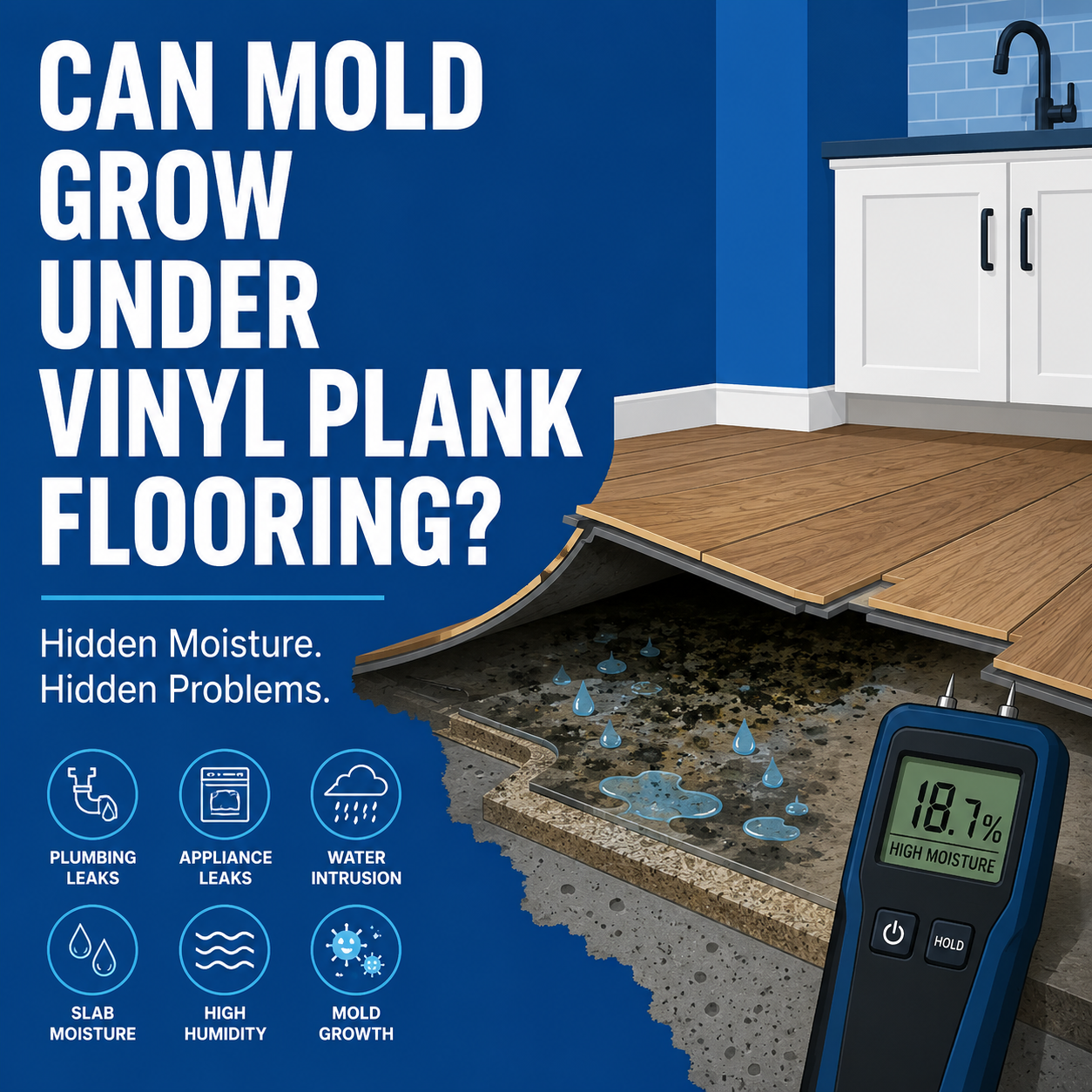
Yes, mold can grow under vinyl plank flooring when moisture becomes trapped beneath the flooring system. The vinyl itself may not support significant mold growth, but dust, adhesive residue, underlayment, drywall paper, wood subflooring, and other organic materials below or around it can.
This condition is often difficult to identify because the finished floor may appear normal even when moisture is present underneath.
Why Moisture Becomes Trapped Under Vinyl Plank Flooring
Luxury vinyl plank flooring is designed to resist surface moisture. That can be helpful when spills are cleaned promptly, but it can also create a concealed moisture problem when water enters from below or travels beneath the flooring.
Once water reaches the underside of the planks, evaporation may be limited. The flooring can slow drying and hold moisture against the slab, underlayment, or wood subfloor.
Common sources include:
- Plumbing leaks
- Dishwasher or refrigerator supply line leaks
- Water heater failures
- Overflowing sinks, toilets, or washing machines
- Rainwater intrusion
- Foundation or slab moisture
- Wet mopping or repeated surface water exposure
- Moisture trapped during flooring installation
The visible edge of the leak may represent only a small portion of the affected area. Water can travel beneath floating flooring systems and spread well beyond the original source.
Can Mold Grow Directly on Vinyl Flooring?
Vinyl is generally not considered a strong food source for mold. However, real flooring systems contain more than vinyl.
Mold may grow on:
- Dust and debris beneath the planks
- Cork or fiber underlayment
- Paper-backed materials
- Wood subflooring
- Baseboards and drywall
- Adhesive residue
- Organic material deposited on the slab
During inspections, suspect growth is sometimes found beneath flooring even when the plank surface remains clean. The affected material may be the underlayment, subfloor, wall base, or accumulated debris rather than the vinyl itself.
Signs of Moisture Under Vinyl Plank Flooring
Hidden flooring moisture does not always create an obvious stain. Homeowners may first notice changes in the way the floor looks, feels, or smells.
Possible signs include:
- Musty odors near the floor
- Planks separating at the seams
- Buckling or lifting
- Soft or uneven areas
- Moisture appearing between plank joints
- Darkened baseboards
- Swollen door casings
- Loose quarter-round trim
- Discoloration at wall edges
- A hollow or different sound when walking
These signs do not prove that mold is present. They indicate that additional evaluation may be appropriate.
Slab-on-Grade Homes Require Special Consideration
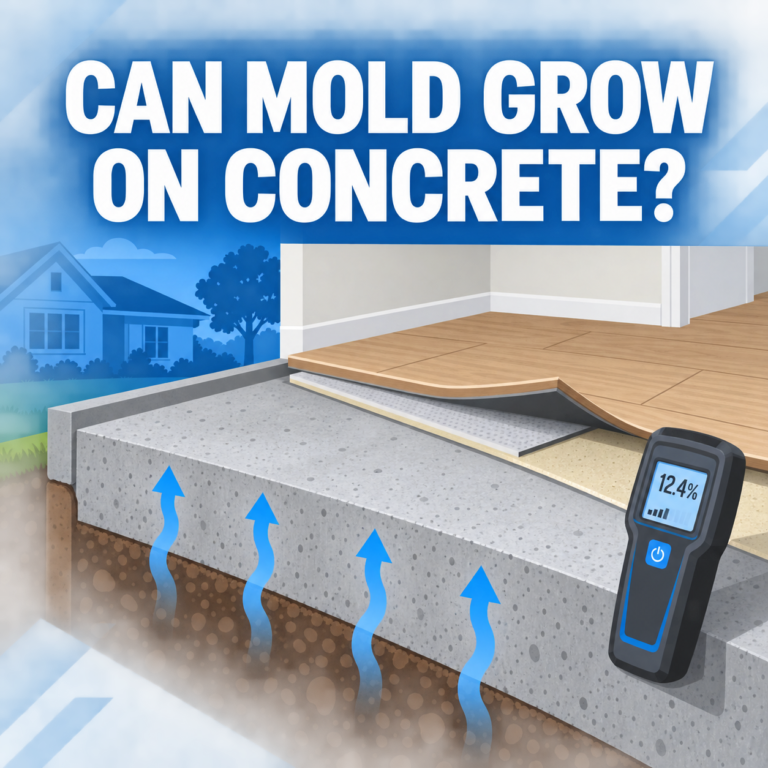
Many North Texas homes are built on concrete slab foundations. Vinyl plank flooring is frequently installed directly over the slab or over a thin underlayment.
Concrete can contain and transmit moisture even when it appears dry at the surface. Moisture vapor may move through the slab and become trapped beneath flooring, particularly when:
- A vapor retarder is missing or damaged.
- The slab was not sufficiently dry before installation.
- Expansive clay soil remains wet around the foundation.
- Exterior drainage directs water toward the home.
- A plumbing leak occurs beneath or near the slab.
- Flooring has very low vapor permeability.
The presence of moisture beneath vinyl flooring does not automatically mean there is a foundation failure or plumbing leak. The moisture source must be evaluated rather than assumed.
Plumbing Leaks Can Spread Beyond the Visible Damage
A dishwasher, refrigerator, sink, or water heater leak may release water at one location while affecting flooring several feet away.
Floating plank flooring can allow water to travel through seams, beneath underlayment, and along low areas in the slab. The water may then emerge at a doorway, cabinet base, or adjacent room.
This is why the first visible wet area is not always the source.
During a moisture investigation, readings are often collected in a grid pattern to determine how far the moisture extends. This process, commonly called moisture mapping, can help identify the general pattern and guide selective flooring removal.
How Inspectors Evaluate Moisture Beneath Flooring
An inspection usually begins with non-destructive methods before flooring is removed.
Common evaluation methods include:
- Visual inspection
- Moisture meter screening
- Thermal imaging
- Indoor humidity measurements
- Inspection of baseboards and wall edges
- Review of plumbing and water-loss history
- Comparison readings in unaffected areas
Moisture meters can help locate areas that differ from surrounding materials, but the readings require interpretation.
Some meters respond to density, adhesives, metallic components, or conductive materials beneath the floor. A high reading does not by itself prove that liquid water or mold is present.
Thermal imaging may reveal temperature differences associated with evaporation, but it does not directly detect moisture. Confirmation usually requires moisture meter readings, physical access, or both.
Why Flooring Removal May Be Necessary
When moisture appears trapped beneath vinyl plank flooring, limited removal may be needed to determine the condition of the materials below.
Removing several planks can help answer important questions:
- Is the slab or subfloor still wet?
- Is the underlayment damaged?
- Is there visible suspect microbial growth?
- How far has the moisture spread?
- Can the flooring be dried and reinstalled?
- Does the source appear active or historical?
Flooring should not be removed without considering whether the affected area may contain mold. Disturbing contaminated materials can release settled dust and fungal fragments into the occupied space.
Can Wet Vinyl Plank Flooring Be Saved?
The answer depends on the flooring construction, water source, duration, and materials beneath it.
| Condition | Typical Consideration |
|---|---|
| Clean water exposure corrected quickly | Planks may sometimes be removed, dried, and reinstalled |
| Water trapped for an extended period | Underlayment and adjacent materials may require removal |
| Swollen fiberboard core | Replacement is commonly necessary |
| Visible mold beneath flooring | Professional remediation may be appropriate |
| Sewage or contaminated water | Porous materials are typically discarded |
| Moisture rising through slab | Source correction is needed before new flooring is installed |
Click-lock planks may be reusable if they are removed without damage and remain dimensionally stable. Adhesive-backed flooring is less likely to be salvageable once removed.
Air Sampling May Not Identify a Flooring Problem
Mold beneath vinyl flooring can remain isolated from the room air, especially when the planks and baseboards remain intact.
An indoor air sample may not show a significant elevation even when localized growth exists beneath the floor. Conversely, an elevated air sample does not identify the flooring as the source.
Air sampling should therefore be interpreted with:
- Moisture findings
- Visual observations
- Building history
- Material conditions
- The location of suspected sources
A moisture investigation is usually more useful than relying on air sampling alone when the concern involves concealed flooring.
What Homeowners Should Do After a Leak
After a water loss involving vinyl plank flooring:
- Stop the water source.
- Remove standing water.
- Document the affected area.
- Check nearby baseboards, cabinets, and walls.
- Avoid assuming the floor is dry because the surface feels dry.
- Begin drying promptly.
- Seek professional evaluation if moisture may be trapped beneath the floor.
Fans and dehumidifiers may help reduce room humidity, but they may not dry water sealed beneath low-permeability flooring.
When Professional Evaluation May Be Appropriate
A mold or moisture assessment may be appropriate when:
- The floor remains damp after drying efforts.
- A musty odor persists.
- Planks are buckling or separating.
- Water traveled beneath cabinets or walls.
- The leak was not discovered promptly.
- Moisture readings remain elevated.
- The water source is uncertain.
- Visible suspect growth is found beneath removed flooring.
The purpose of the evaluation is to determine the moisture source, affected area, and reasonable next steps before extensive demolition begins.
Frequently Asked Questions
How long can water stay under vinyl flooring?
Water can remain beneath vinyl flooring for days or longer when evaporation is restricted. Drying time depends on the amount of water, flooring system, subfloor, temperature, humidity, and air movement.
Will a dehumidifier dry water under vinyl plank flooring?
A dehumidifier can reduce moisture in the room, but it may not fully dry water trapped beneath tightly fitted flooring. Partial removal may be necessary to expose the wet materials.
Can mold grow between vinyl flooring and concrete?
Yes. Mold may grow on dust, underlayment, adhesive residue, or other organic debris between the vinyl flooring and concrete, even though the concrete and vinyl themselves are not strong food sources.
Does buckled vinyl flooring mean there is mold underneath?
No. Buckling may result from moisture, improper installation, inadequate expansion spacing, heat, or subfloor movement. Further inspection is needed to determine the cause.
Should all the flooring be removed after a leak?
Not necessarily. The removal area should be based on moisture mapping, visible damage, the duration of exposure, and the flooring installation method.
Mold can develop beneath vinyl plank flooring when water becomes trapped against underlayment, wood subflooring, drywall edges, adhesives, or accumulated debris. The finished surface may look dry while moisture remains below.
A proper investigation should focus on identifying the source, mapping the affected area, and determining whether selective flooring removal is necessary. Correcting the moisture condition is essential before replacement flooring is installed.
Related Articles
- Why Moisture Mapping Is Critical Before Mold Remediation in Texas Homes
- What Do Moisture Meter Readings in Walls Really Mean?
- How Do I Know If a Water Leak Has Caused Hidden Mold?
- How Long Does It Take for Mold to Grow After Water Damage?
Dennis Butts is a Texas licensed Mold Assessment Consultant and principal of NTX Enviro Consulting Services, providing mold inspections, remediation protocols, and post remediation verification services throughout North Texas.
NTX Enviro provides professional mold inspections and moisture evaluations for homeowners throughout North Texas.

[…] Can Mold Grow Under Vinyl Plank Flooring? […]