📞 (972) 643-8379 Monday to Friday 8:00 am - 5:00 pm, Saturday & Sunday - CLOSED

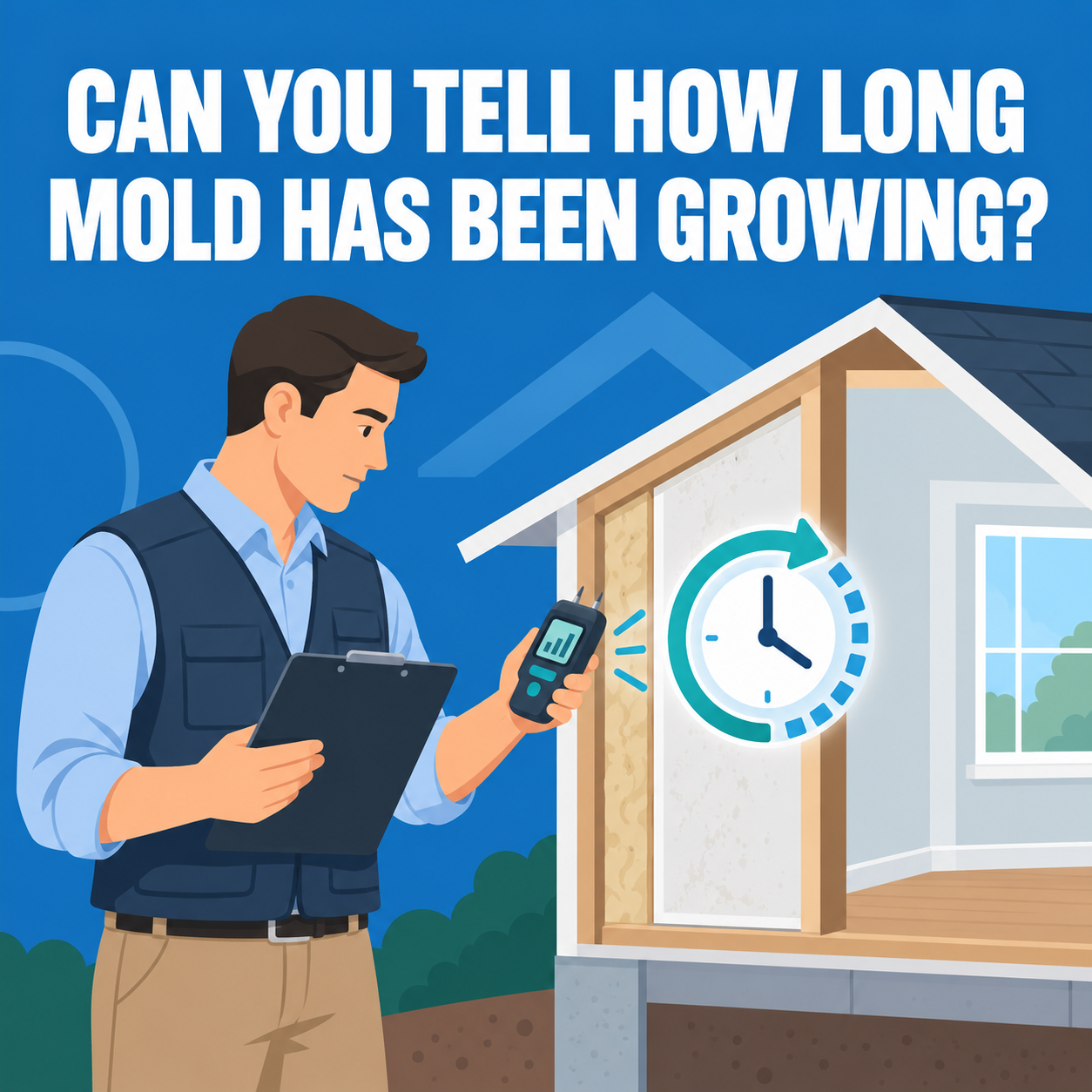
Can You Tell How Long Mold Has Been Growing in a Home?

A mold inspection usually cannot determine exactly how long mold has been growing. The types of fungi present, the condition of affected materials, and evidence of moisture exposure may suggest whether a problem is recent, recurring, or long-term, but they ordinarily cannot establish a reliable start date.
This distinction can be important during a home purchase, insurance claim, landlord-tenant dispute, or investigation of a previously repaired leak. Homeowners understandably want to know not only why mold developed, but also when the problem began. The available evidence may help establish a general moisture timeline, but it rarely supports a precise date.
Why Mold Usually Cannot Be Dated Precisely
Mold does not grow according to a predictable calendar. Its development depends on the material involved, available moisture, temperature, humidity, airflow, and the fungal spores already present.
Under favorable conditions, fungal growth can begin relatively quickly. However, that does not mean every visible colony developed within a specific number of hours or days. Building materials may become wet, partially dry, and then become wet again. Growth may remain concealed for months before it is discovered. A previously active area may also be dry at the time of the inspection.
Because of these variables, an inspector generally cannot look at fungal growth and responsibly state that it began on a particular date.
The more supportable conclusion is often that the affected material experienced enough moisture to support growth at some point before the inspection.
What Mold Appearance Can and Cannot Reveal
Homeowners sometimes assume that dark, widespread, or heavy growth must be old. Others believe light-colored or limited growth must have developed recently. Neither assumption is consistently reliable.
The visible extent of growth can be influenced by:
- The type of building material
- The amount and duration of moisture exposure
- Whether the area remained continuously wet
- Indoor temperature and humidity
- Air movement within the space
- Previous cleaning or painting
- Whether the material was disturbed
- The types of fungi present
A small area may result from a long-term, low-level moisture condition. More extensive growth may develop relatively quickly following a significant water event.
Color is also not a dependable indicator of age. Fungal growth can appear black, green, gray, brown, orange, or white depending on the organism, substrate, lighting, environmental conditions, and stage of development.
Appearance may contribute to the overall investigation, but it should not be used as a clock.
Can the Type of Mold Help Determine How Long It Has Been Growing?
The type of mold identified may provide some information about the conditions that supported its growth, but it generally cannot establish exactly when the growth began.
Some fungi can grow under relatively limited moisture conditions, while others are more commonly associated with materials that have remained wet for an extended period or experienced repeated wetting. When fungi associated with sustained moisture are found in meaningful concentrations or identified directly on affected materials, the results may support other evidence of a prolonged or recurring moisture condition.
Fungal ecology is influenced by many variables, including:
- The amount of available moisture
- How long the material remained wet
- The type of material or surface
- Temperature
- Air movement
- Available nutrients
- Competition among fungal organisms
- Repeated wetting and drying cycles
The same type of fungus may develop at different rates under different building conditions. Multiple fungal types may also be present when a moisture condition has continued or changed over time.
Laboratory identification is therefore most useful when interpreted together with visible growth, material deterioration, moisture mapping, the suspected water source, and the history of the property. The fungal type may help characterize the moisture environment and strengthen a conclusion about sustained or recurring wetness, but it does not provide a reliable start date by itself.
Can Laboratory Testing Determine the Age of Mold?
Laboratory testing cannot ordinarily determine the specific age of mold growth.
Air samples provide information about airborne fungal spores at the time and location of collection. Surface samples may identify fungal structures present on a particular material. Neither type of sample normally establishes when the growth began.
A high airborne spore concentration does not necessarily mean the condition is older than an area with a lower concentration. Airborne results are affected by disturbance, ventilation, HVAC operation, occupant activity, weather, sampling location, and whether the growth is exposed or concealed.
Surface samples may provide more direct information about the types of fungi present on an affected material. This can help evaluate whether the fungal ecology is consistent with the observed moisture condition. Even then, the laboratory cannot assign a calendar date to the growth.
Laboratory analysis can contribute to a timeline evaluation, but the results must be interpreted within the context of the entire building investigation.
Evidence That May Help Establish a Moisture Timeline
Although mold usually cannot be dated precisely, other information may help develop a reasonable moisture history. During an assessment, the most useful evidence often comes from the building and its records rather than from any single laboratory result.
Potential timeline evidence includes:
- Documented water events
Plumbing invoices, roof repair records, insurance claims, maintenance requests, and dated photographs may establish when a known water event occurred.
- Moisture staining and material deterioration
Layered staining, deteriorated drywall facing, delaminated cabinetry, swollen wood products, corrosion, and damaged finishes may suggest repeated or prolonged exposure. These observations still do not establish an exact date.
- Moisture mapping
A moisture survey may show whether affected materials are currently elevated compared with surrounding materials. The pattern of elevated readings can also help identify the direction of moisture migration and the likely source.
- Previous repairs
Patches, replaced drywall, new paint, plumbing modifications, or roofing repairs may indicate that the area has experienced a prior problem. Repair dates can provide useful context when records are available.
- Occupant observations
The date when an odor, stain, leak, or surface change was first noticed can help narrow the timeline. However, the date of discovery is not necessarily the date the condition began.
- Weather history
When roof or exterior water intrusion is suspected, the timing of severe thunderstorms, wind-driven rain, hail, or prolonged rainfall may be relevant. In North Texas, multiple storms can affect the same building component before interior damage becomes visible.
Signs of Recurring or Long-Term Moisture Exposure
Certain conditions may support the conclusion that moisture exposure has occurred repeatedly or over an extended period.
Examples include:
- Multiple layers or patterns of water staining
- Deterioration affecting several material layers
- Repeated repair patches or coatings
- Corrosion around plumbing components
- Swelling or delamination of engineered wood products
- Fungal ecology associated with sustained wetness
- Similar damage appearing in adjoining materials
- A documented history of recurring leaks
In slab-on-grade homes, water may also migrate beneath flooring or through adjacent materials before becoming apparent. Expansive clay soils can contribute to movement around foundations, plumbing systems, and exterior interfaces, but the presence of movement alone does not prove when a specific moisture problem began.
An inspector may be able to report that the observed conditions are consistent with recurring or prolonged moisture exposure without claiming that the mold is a specific number of weeks, months, or years old.
Why Dry Materials Do Not Prove the Mold Is Old
A common misconception is that dry materials mean the fungal growth must be old or inactive.
Moisture readings represent conditions at the time of the inspection. A material that is dry today may have been wet several days earlier. A plumbing leak may have stopped, rainwater may have evaporated, or air conditioning may have reduced indoor humidity before the assessment.
Visible fungal growth can remain on a material after it dries. Spores and fragments may also become airborne when affected materials are disturbed.
Conversely, elevated moisture does not prove that visible growth began recently. The area may have experienced several wetting events over time.
This is why moisture measurements must be evaluated together with visible conditions, material damage, fungal ecology, occupant history, and the suspected source.
How Long Mold Has Been Growing Versus How Long the Leak Existed
The moisture source and the fungal growth do not necessarily share the same timeline.
A slow plumbing leak may exist before enough moisture accumulates to support visible growth. A roof opening may leak only during storms from a particular direction. Condensation may occur seasonally when a surface falls below the dew point. An HVAC-related humidity problem may develop gradually during the cooling season.
It may be possible to establish when a leak was reported or repaired without knowing exactly when fungal growth began.
A careful investigation should separate these questions:
- When was the moisture condition first documented?
- Is the material currently wet?
- Is there evidence of prior or recurring moisture?
- Where is fungal growth visible or suspected?
- What types of fungi were identified?
- Does the fungal ecology fit the observed moisture conditions?
- When was the affected area last known to be dry and undamaged?
The answers may help narrow the timeline, but they rarely establish an exact date.
What a Mold Assessment Can Responsibly Conclude
A mold assessment can document current conditions, identify evidence of moisture exposure, evaluate accessible building materials, and investigate potential moisture sources. Environmental sampling may also help characterize fungal conditions when sampling is appropriate for the investigation.
Depending on the available evidence, a report may reasonably conclude that:
- Fungal growth is present on specific materials.
- Materials are currently wet or elevated in moisture.
- Conditions are consistent with a recent water event.
- Observed deterioration suggests recurring or prolonged moisture exposure.
- The identified fungal ecology supports evidence of sustained wetness.
- The affected area was previously repaired or painted.
- The precise beginning of fungal growth cannot be determined.
- Additional invasive investigation may be needed to evaluate concealed conditions.
The conclusion should remain within what the evidence supports. Statements assigning an exact age to mold without documentation or other reliable evidence can create a false sense of certainty.
When a Professional Evaluation May Be Appropriate
A professional mold assessment may be useful when the timeline affects a property transaction, insurance matter, responsibility dispute, or remediation decision. It may also be appropriate when there is visible growth, a persistent musty odor, unexplained staining, recurring moisture, or concern about concealed damage.
Homeowners should understand that the purpose of the assessment is not to manufacture a precise date. The goal is to document present conditions, identify contributing moisture factors, evaluate the apparent extent of the problem within the limitations of the inspection, and provide recommendations based on the available evidence.
Frequently Asked Questions
Can an inspector tell whether mold is new or old?
An inspector may identify evidence suggesting recent, recurring, or prolonged moisture exposure. The type of mold found may contribute to that evaluation, but the inspector usually cannot determine the exact age of the growth.
Can certain types of mold indicate a long-term moisture problem?
Yes. Some fungi are more commonly associated with materials that have experienced sustained or repeated wetting. Their presence may support other evidence of a long-term moisture condition, but it does not establish exactly when the growth began.
Does black mold mean the problem has been there a long time?
No. Color does not reliably indicate age, toxicity, or duration. Dark growth can develop under different moisture conditions and on many types of materials.
Can a high mold spore count show that growth is old?
No. Airborne spore concentrations reflect conditions during the sampling period and can be affected by disturbance, ventilation, weather, HVAC operation, and other variables. A high concentration does not provide a reliable age.
If the wall is dry, does that mean the mold is from an old leak?
Not necessarily. The wall may have dried after a recent leak, or it may experience intermittent moisture that is not active during the inspection. Current moisture readings represent only one part of the investigation.
It is rarely possible to determine exactly how long mold has been growing in a home. Mold appearance, color, and laboratory results do not provide a dependable start date.
The types of fungi identified can still provide useful information. Certain fungal findings may support evidence that materials experienced sustained or recurring moisture, especially when interpreted with moisture mapping, material deterioration, repair history, documented water events, and current building conditions.
The most reliable conclusions distinguish between what is documented, what the physical and laboratory evidence suggests, and what cannot be determined with reasonable certainty.
Related Articles
- How Do I Know If a Water Leak Has Caused Hidden Mold?
- What to Expect During a Mold Inspection
- Understanding the Difference Between Mold Assessment and Mold Testing
- The 48 Hour Rule: How Quickly Can Mold Grow After Water Damage?
Dennis Butts is a Texas licensed Mold Assessment Consultant and principal of NTX Enviro Consulting Services, providing mold inspections, remediation protocols, and post remediation verification services throughout North Texas.
NTX Enviro provides professional mold inspections and moisture evaluations for homeowners throughout North Texas.