📞 (972) 643-8379 Monday to Friday 8:00 am - 5:00 pm, Saturday & Sunday - CLOSED

Can Mold Grow on Concrete? Causes and Next Steps

Yes, mold can grow on a concrete surface when sufficient moisture and organic material are available. Concrete itself provides limited nutrients, but dust, dirt, paint, flooring adhesives, paper backing, and materials installed over the concrete can support fungal growth. The underlying moisture source must be identified before the condition can be corrected effectively.
In North Texas homes, this question often arises after flooring is removed from a slab-on-grade foundation. Homeowners may find dark staining on the concrete, discoloration on the back of the flooring, or a musty odor coming from the exposed area. Some of these conditions involve fungal growth, while others are caused by adhesive, minerals, soil, or previous flooring materials.
How Can Mold Grow on Concrete?
Mold requires moisture, a suitable temperature, and a source of nutrients. Although concrete is primarily mineral-based, its surface rarely remains completely clean in an occupied home.
Concrete can collect or become covered by:
- Household dust
- Soil and organic debris
- Paint or other coatings
- Flooring adhesive
- Drywall dust
- Paper or fabric flooring backings
- Wood framing or baseboards
- Carpet padding
- Residue from previous water damage
When these materials remain damp, they may support fungal growth on or immediately above the concrete.
Concrete is also porous. Water and water vapor can move through its pore structure, and the surface can retain moisture under certain conditions. This moisture may affect flooring adhesives, underlayments, baseboards, drywall, and other moisture-sensitive materials in contact with the slab.
Is the Mold Growing on the Concrete or on Material Above It?
What appears to be mold growing directly on concrete may actually be growing on dust, adhesive, paint, sealers, or residue attached to the surface.
This distinction can be difficult to make visually. For example, after carpet is removed, the concrete may contain old adhesive, deteriorated padding, dirt, and irregular dark stains. Under vinyl plank flooring, fungal growth may be located on the underlayment, flooring backing, adhesive, baseboards, or drywall rather than within the concrete itself.
During an inspection, the important questions are:
- Is the discoloration fungal growth or another material?
- What material is actually affected?
- Is the concrete or adjacent material currently damp?
- How did the moisture reach the area?
- Does the condition extend beneath walls, cabinets, or adjoining flooring?
The answers determine whether surface cleaning may be appropriate or whether additional materials must be removed and evaluated.
What Causes Moisture in a Concrete Slab?
Concrete can contain or encounter moisture for several reasons. Moisture at the slab surface does not automatically mean that the foundation is defective.
Potential sources include:
- A plumbing leak above or below the slab
- Water from a failed appliance or plumbing fixture
- Rainwater entering through an exterior wall or doorway
- Moisture vapor moving through the slab
- Condensation on a cool slab surface
- Improper exterior drainage
- A missing, damaged, or ineffective vapor retarder
- Moisture trapped beneath low-permeability flooring
- Water introduced during construction
- Wet cleaning methods or repeated spills
Determining the source requires more than observing that the concrete appears damp. The location, pattern, duration, surrounding materials, weather conditions, and plumbing history should all be considered.
In North Texas, expansive clay soils and slab-on-grade construction can complicate moisture investigations. Foundation movement may affect plumbing or exterior interfaces, but movement alone does not prove the source of a moisture condition. Plumbing, drainage, building-envelope, and flooring factors may require separate evaluation.
Can Moisture Move Through a Concrete Slab?
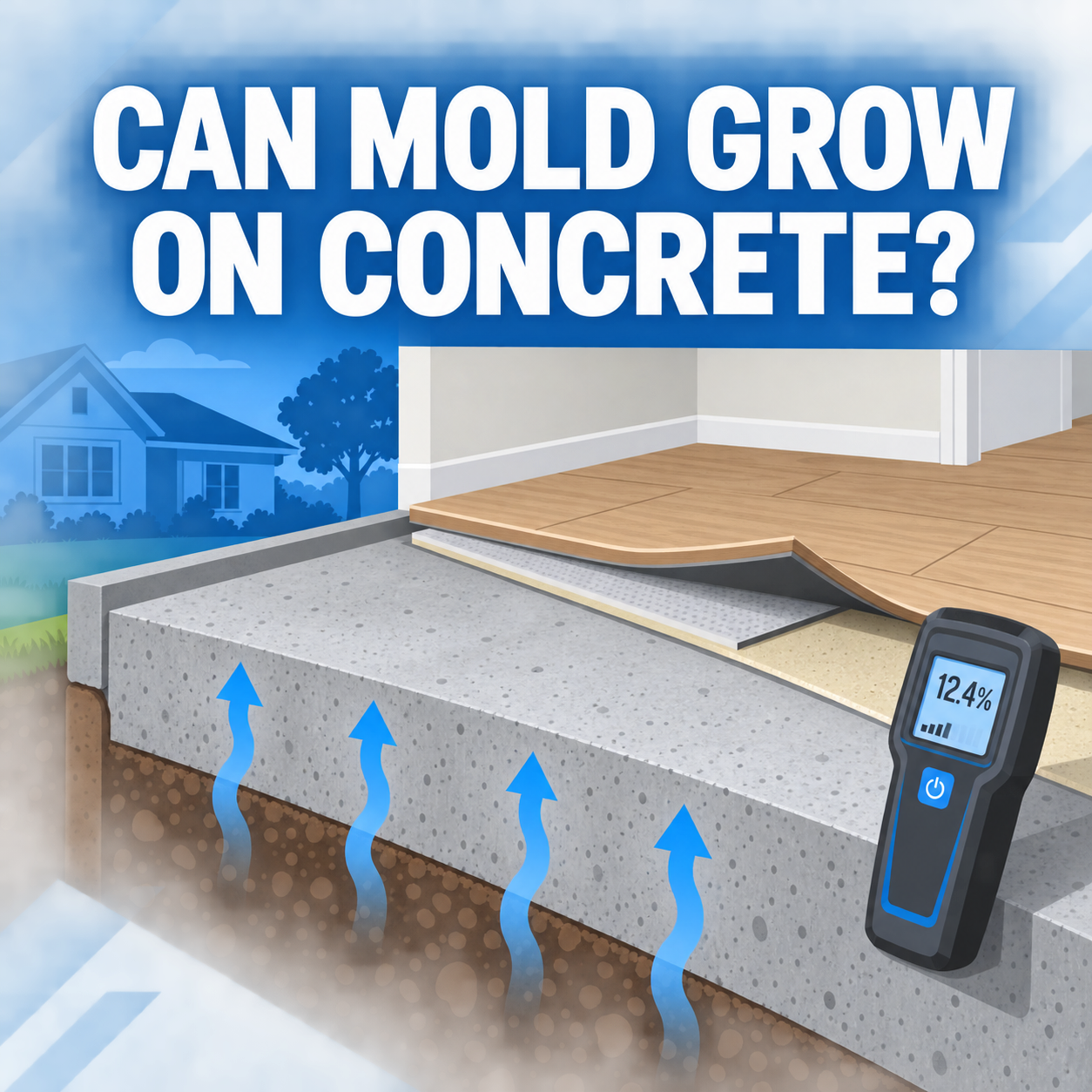
Yes. Concrete is porous, and water vapor can move through it when differences in moisture and vapor pressure exist between the soil, slab, and indoor environment.
A properly installed vapor retarder beneath the slab is intended to limit moisture migration from the soil. However, older homes may have no effective vapor retarder, and even newer slabs may experience localized moisture issues related to penetrations, construction conditions, plumbing leaks, or flooring installation.
Moisture moving through a slab can become more noticeable after impermeable or low-permeability flooring is installed. Vinyl plank, sheet vinyl, certain coatings, and some flooring systems can slow evaporation into the room. Moisture may then affect adhesives, underlayments, flooring backings, and nearby walls.
The resulting condition may include:
- Flooring discoloration
- Adhesive failure
- Loose or lifting flooring
- Musty odors
- Deteriorated underlayment
- Elevated moisture at baseboards or drywall
- Fungal growth on moisture-sensitive materials
The presence of mold does not establish whether the moisture came through the slab, leaked from plumbing, or entered from another source. That requires an investigation.
Does White Material on Concrete Mean Mold?
White residue on concrete is often assumed to be mold, but it may be efflorescence.
Efflorescence is a mineral deposit left behind when moisture moves through masonry and evaporates. Dissolved salts travel with the moisture and remain on the surface after the water dries. The residue may appear white, powdery, crystalline, or fluffy.
Efflorescence is not mold. However, it can be evidence that moisture has moved through the concrete or masonry.
Other conditions that may resemble mold include:
- Flooring adhesive
- Paint residue
- Mineral deposits
- Concrete curing compounds
- Dust
- Soil
- Oxidation or staining
- Deteriorated carpet padding
Visual appearance alone may not be sufficient to identify the material. Surface sampling can sometimes help when the result would affect the recommendations, but sampling should be interpreted with the surrounding moisture conditions.
Does Black Staining on Concrete Mean Mold?
Not necessarily. Black or dark discoloration may be fungal growth, but it can also result from adhesive, dirt, rubber-backed flooring, previous coatings, tracked soil, or chemical reactions.
Mold cannot be identified reliably by color alone. Different fungi can appear black, green, gray, white, brown, or other colors, and nonfungal materials may have a similar appearance.
An inspector may evaluate whether the material has a growth-like pattern, whether it can be transferred from the surface, whether nearby materials are affected, and whether a moisture source is present. When visual observations are inconclusive, a surface sample may provide additional information.
Can Mold Grow Under Flooring Installed Over Concrete?
Yes. Flooring assemblies installed over concrete can create conditions that support fungal growth when moisture becomes trapped.
The concrete may not be the primary food source. Growth may instead occur on:
- Flooring adhesive
- Dust and debris on the slab
- Paper-backed products
- Cork or fiber underlayment
- Carpet backing and padding
- Wood-based flooring
- Baseboards
- Drywall touching or located close to the slab
A floating vinyl plank floor can conceal moisture without showing immediate damage on its upper surface. Water may migrate beneath multiple planks and extend beyond the location where the leak began. The underside of the flooring, underlayment, baseboards, and walls may require evaluation.
Removing one plank or checking only the visibly affected area may not reveal the full moisture pattern.
How Is Moisture in Concrete Evaluated?
Concrete moisture cannot always be evaluated accurately with the same approach used for drywall or wood.
A handheld moisture meter may help identify relative differences across a floor, but many meters do not provide a direct percentage of moisture within concrete. Reinforcement, surface coatings, salts, density, depth, and other material properties can influence readings.
Depending on the purpose of the investigation, evaluation may include:
- Relative moisture mapping across the surface
- Comparison with apparently unaffected areas
- Indoor temperature and relative humidity measurements
- Dew-point evaluation
- Inspection of flooring and adhesive
- Plumbing leak investigation
- In-slab relative humidity testing
- Moisture vapor emission testing
- Review of drainage and exterior conditions
Formal concrete moisture testing may be needed before new flooring is installed. A mold assessment and a flooring moisture evaluation answer related but different questions.
Can Mold Be Cleaned From Concrete?
Concrete can often be cleaned when it is structurally sound, accessible, and the fungal growth is limited to a cleanable surface. The proper method depends on the condition, project size, contamination, surrounding materials, and moisture source.
Effective cleaning generally focuses on physical removal of the fungal growth and residue rather than simply applying a chemical intended to kill mold. The area must also be dried, and the underlying moisture source must be corrected.
Cleaning may be more difficult when:
- The surface is rough or highly porous
- Adhesive or coatings are present
- Contamination extends into cracks or joints
- The slab remains damp
- Porous flooring materials are still installed
- Growth extends beneath walls or cabinets
- Sewage or other contaminated water was involved
Painting or sealing over an unresolved moisture condition may trap moisture or conceal remaining contamination. Coatings should not be treated as a substitute for proper investigation and cleaning.
When Should a Professional Assessment Be Considered?
A professional mold and moisture assessment may be appropriate when:
- A musty odor remains after flooring is removed
- Discoloration covers a large or uncertain area
- Adjacent drywall, baseboards, cabinets, or flooring are affected
- The moisture source is unknown
- Flooring damage continues to return
- Moisture may extend beneath walls or cabinets
- A plumbing leak occurred below the slab
- New flooring is planned before the cause is understood
- There is a dispute about the extent or source of the condition
A Texas licensed Mold Assessment Consultant can evaluate accessible materials, map moisture patterns, determine whether environmental sampling would be useful, and develop a remediation protocol when warranted.
A mold assessment does not replace specialized plumbing, foundation, drainage, or flooring testing. These disciplines may need to work together when the source involves more than one building system.
Frequently Asked Questions
Can mold grow on a garage floor?
Yes. Mold may grow on dust, dirt, coatings, stored materials, or other organic residue on a damp garage floor. Dark staining can also have nonfungal causes, so appearance alone is not conclusive.
Can mold grow inside concrete?
Most visible fungal growth associated with concrete occurs on the surface or on materials and residue attached to it. Concrete pores, cracks, coatings, and accumulated debris can complicate cleaning, but mold should not be assumed to be growing throughout the entire slab.
Will sealing concrete stop mold from returning?
A sealer may be part of a properly designed flooring or moisture-management system, but it will not correct every moisture source. Plumbing leaks, exterior water intrusion, condensation, and excessive indoor humidity must be evaluated separately.
Can mold under flooring spread into walls?
Moisture and fungal growth can extend from a flooring assembly to baseboards, drywall, cabinetry, or other adjoining materials. The extent depends on the water source, duration, materials, and path of moisture migration.
Should concrete be tested for mold before new flooring is installed?
Testing is not automatically necessary for every slab. If visible growth, unexplained staining, persistent odors, or prior water damage is present, an assessment may be appropriate before the condition is concealed by new flooring.
Mold can grow on a concrete surface when moisture and a suitable food source are present. The nutrients often come from dust, dirt, adhesives, coatings, flooring materials, or nearby building components rather than from the concrete itself.
Dark or white discoloration is not automatically mold. Adhesives, minerals, soil, and previous coatings can produce a similar appearance. The condition should be evaluated in relation to moisture, affected materials, and the history of the property.
Correcting the problem requires more than cleaning the visible surface. The moisture source must be identified, affected materials must be evaluated, and the slab or flooring assembly must be dry and suitable before new finishes are installed.
Related Articles
- Can Mold Grow Under Vinyl Plank Flooring?
- Why Moisture Mapping Is Critical Before Mold Remediation in Texas Homes
- What Humidity Level Causes Mold Growth in Homes?
- What Are the Most Common Causes of Indoor Moisture Problems in Homes?
Dennis Butts is a Texas licensed Mold Assessment Consultant and principal of NTX Enviro Consulting Services, providing mold inspections, remediation protocols, and post remediation verification services throughout North Texas.
NTX Enviro provides professional mold inspections and moisture evaluations for homeowners throughout North Texas.