📞 (972) 643-8379 Monday to Friday 8:00 am - 5:00 pm, Saturday & Sunday - CLOSED

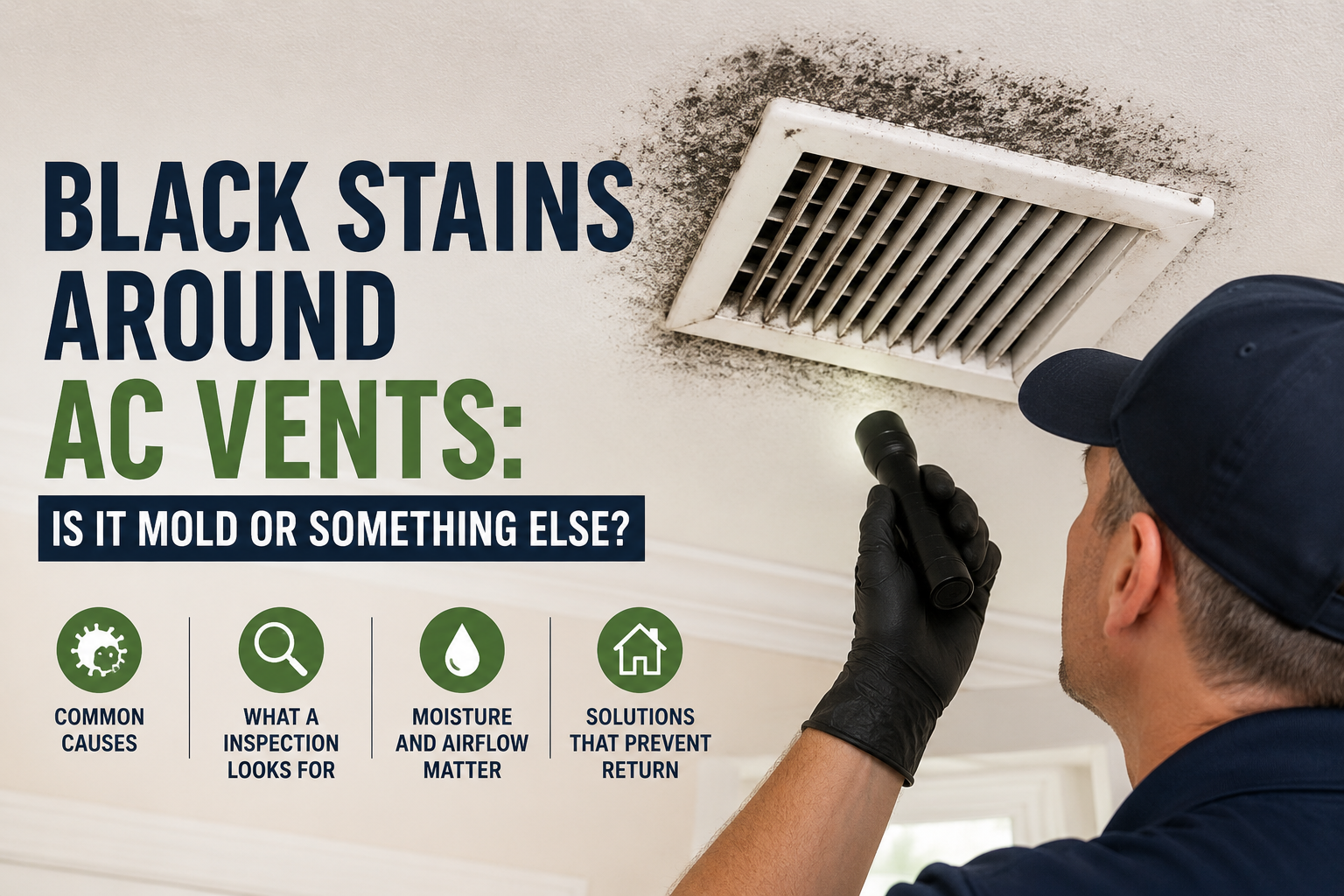
Black Stains Around AC Vents: Is It Mold or Something Else?

Many homeowners become concerned when they notice dark discoloration around their ceiling air conditioning vents. While mold is one possible explanation, black stains around AC vents are often caused by a combination of airborne dust, condensation, and HVAC airflow patterns. Determining the true cause requires evaluating both the staining itself and the moisture conditions that allowed it to develop.
Why Black Stains Form Around Air Vents
One of the most common inspection questions is whether dark rings around supply registers indicate mold growth.
The answer is: sometimes, but not always.
During many North Texas mold inspections, dark staining around supply vents turns out to be ordinary dust that has accumulated where conditioned air mixes with warmer, more humid indoor air. This phenomenon is often called thermal tracking or filtration soiling.
As air continuously moves through the register, tiny airborne particles collect around the edges of the vent. Over time, the staining becomes increasingly noticeable.
In other situations, condensation forms around the register because the cold metal surface drops below the dew point of the surrounding indoor air. When moisture is repeatedly present, microbial growth may eventually develop.
The appearance alone cannot reliably distinguish between dust staining and mold growth.
Common Causes of Black Staining Around Supply Registers
Several conditions commonly contribute to dark staining around HVAC vents:
- Elevated indoor humidity
- Condensation on cold metal registers
- Air leakage around poorly sealed duct boots
- Dirty HVAC filters allowing increased particulate circulation
- High airborne dust levels
- Minor microbial growth on painted drywall or the register itself
Often, more than one factor is present simultaneously.
For example, an older home may have slightly elevated indoor humidity during the summer while also having small air leaks around the duct boot. The escaping cold air creates localized cooling of the ceiling surface, allowing dust to collect while intermittent condensation supports additional staining.
Why This Is Common in North Texas
North Texas homes frequently experience long cooling seasons with outdoor humidity remaining relatively high during much of the summer.
Even though an air conditioner removes moisture, several factors can increase the likelihood of condensation around vents:
- Oversized HVAC equipment that short cycles
- High indoor humidity
- Poor attic insulation
- Leaky duct boots
- Inadequate attic ventilation
- Large temperature differences between supply air and room air
Many slab-on-grade homes also experience significant attic temperatures exceeding 130°F during summer afternoons. Small deficiencies in insulation or air sealing around ceiling penetrations can create noticeable temperature differences at the register.
Is It Actually Mold?
Visible black discoloration should never automatically be identified as mold based solely on appearance.
Numerous materials can produce similar-looking stains, including:
| Possible Cause | Typical Characteristics |
|---|---|
| Dust accumulation | Dry, powdery, uniform dark ring |
| Filtration soiling | Follows airflow patterns around register |
| Condensation staining | Often accompanied by water marks |
| Mold growth | May appear fuzzy, irregular, or associated with persistent moisture |
| Paint discoloration | Usually uniform with no visible texture |
Because these conditions can appear similar, visual inspection alone has limitations.
Professional evaluation focuses on identifying the moisture source rather than simply identifying the discoloration.
What a Professional Inspection Looks For
When evaluating stained HVAC registers, the inspection typically includes much more than looking at the vent itself.
Depending on the situation, an assessment may include:
- Indoor temperature and relative humidity measurements
- Moisture meter readings around the ceiling
- Thermal imaging to identify cooling anomalies
- Inspection of attic insulation above the register
- Evaluation of duct boot sealing
- Assessment of HVAC performance
- Inspection for signs of condensation or water intrusion
- Air or surface sampling when appropriate
The objective is to determine why the staining developed and whether conditions exist that could support ongoing microbial growth.
Simply cleaning the register without addressing the underlying moisture issue often results in the staining returning.
Can You Just Clean the Vent?
If the staining is determined to be ordinary dust accumulation with no moisture concerns, cleaning the register and surrounding ceiling may be all that is necessary.
However, if condensation is occurring, the moisture source should be corrected before cosmetic cleaning.
Potential corrective measures may include:
- Reducing indoor humidity.
- Improving HVAC performance.
- Sealing duct boot air leaks.
- Increasing attic insulation.
- Correcting ventilation deficiencies.
- Replacing damaged drywall if microbial growth has occurred.
Addressing the underlying building conditions helps prevent the problem from recurring.
When Should You Schedule a Mold Assessment?
Professional evaluation may be appropriate if:
- The staining continues to return after cleaning.
- Water droplets form on the register.
- You notice a persistent musty odor.
- The ceiling drywall becomes soft or discolored.
- The affected area continues to expand.
- Multiple vents throughout the home show similar staining.
- The staining developed following a roof leak or plumbing leak.
A licensed Mold Assessment Consultant can determine whether microbial growth is actually present and identify the moisture conditions contributing to the problem.
Frequently Asked Questions
Are black AC vents always mold?
No. Dust accumulation and filtration soiling are far more common than mold growth. Moisture must generally be present for mold to develop.
Why do only certain vents have black rings?
Individual vents may experience different airflow patterns, insulation conditions, or localized air leakage around the duct boot, causing staining to occur at only a few locations.
Will replacing the register solve the problem?
Not if condensation or air leakage is causing the staining. The underlying moisture conditions should be corrected first.
Can high indoor humidity cause black stains around vents?
Yes. Elevated humidity increases the likelihood of condensation forming on cold supply registers, which can contribute to staining and, in some cases, mold growth.
Should the air ducts be cleaned?
Not necessarily. Many cases involve staining around the ceiling rather than contamination inside the ductwork. An inspection should determine whether duct cleaning is actually warranted.
Black stains around AC vents do not automatically indicate mold. In many homes, they result from normal dust accumulation, air leakage, or condensation caused by elevated humidity and HVAC performance issues. Identifying the true cause requires evaluating moisture conditions, airflow, and the building envelope rather than relying on appearance alone.
Related Articles
- Why Is There Condensation on My Air Conditioning Vents?
- Can Mold Grow in HVAC Systems and Air Ducts?
- What Humidity Level Causes Mold Growth in Homes?
Dennis Butts is a Texas licensed Mold Assessment Consultant and principal of NTX Enviro Consulting Services, providing mold inspections, remediation protocols, and post remediation verification services throughout North Texas.
NTX Enviro provides professional mold inspections and moisture evaluations for homeowners throughout North Texas.