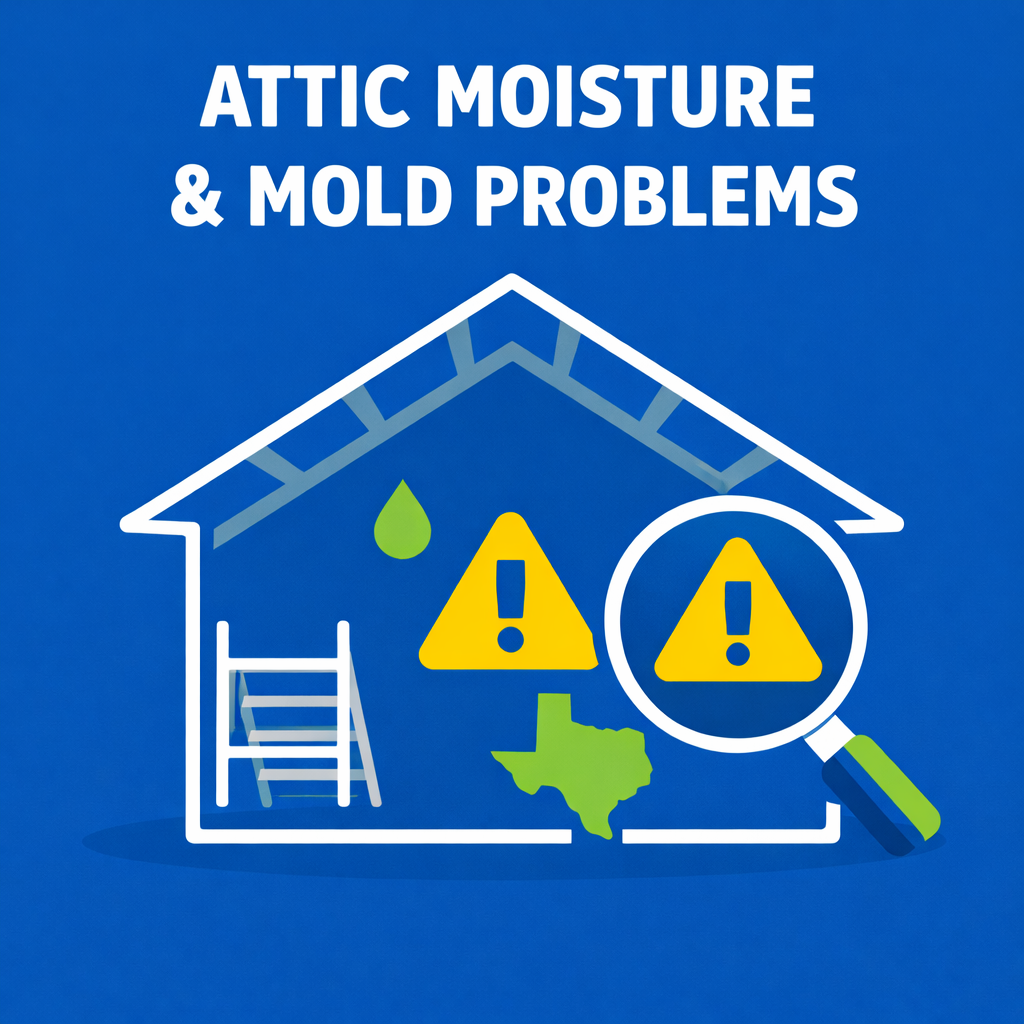
Attics are one of the most common locations for hidden moisture problems in Texas homes, yet they are rarely inspected unless a major issue arises. Because attics are out of sight and infrequently accessed, moisture intrusion and elevated humidity can persist unnoticed, creating conditions that support mold growth over time.
Why Attics Are Vulnerable to Moisture
Texas attics experience extreme temperature swings throughout the year. Warm, moist air from the living space can migrate upward through ceiling penetrations, recessed lighting, and attic access points. When this air contacts cooler surfaces, condensation can form on roof decking, framing, and insulation.
In addition to interior moisture migration, roof leaks, improperly flashed penetrations, and blocked ventilation pathways can introduce water into the attic. These issues often develop slowly and may not produce visible signs inside the home until damage is advanced.
Common Signs of Hidden Attic Moisture
Homeowners are often unaware of attic moisture problems because early indicators are subtle. Rusted fasteners, compressed insulation, staining on roof decking, or a musty odor near ceiling access points may be the only clues.
In some cases, attic related moisture issues are discovered only after mold growth becomes visible on ceiling drywall or when elevated fungal levels are identified during indoor air sampling.
How Mold Can Develop in Attics
When moisture remains elevated, mold may grow on wood framing, roof sheathing, and insulation. These materials provide organic surfaces that readily support microbial growth under the right conditions.
Because attics are typically unconditioned spaces, mold growth may remain confined to the attic for extended periods. However, air movement and pressure differences can allow spores to migrate into the living space, potentially affecting indoor air quality.
When an Attic Mold Assessment Is Needed
A licensed mold assessment consultant can determine whether attic conditions are consistent with active or historical moisture intrusion and mold growth. This includes a visual inspection of accessible attic areas, moisture measurements, and sampling when appropriate.
In Texas, remediation decisions must be based on documented findings. An assessment helps define accurate remediation boundaries and ensures compliance with Texas Mold Assessment and Remediation Rules.
Addressing the Moisture Source
Mold remediation alone is not sufficient if attic moisture sources are not corrected. Improving ventilation, sealing air leaks from the living space, and repairing roof or flashing defects are critical steps in preventing recurrence.
Coordination between the mold assessment consultant and qualified contractors helps ensure that moisture issues are addressed before remediation and that conditions are suitable for clearance.
👉 The 48-Hour Rule: Why Fast Action After Water Damage Prevents Mold
Attic moisture problems often develop quietly and remain hidden until significant damage occurs. In Texas homes, early identification through a professional mold assessment can prevent minor attic moisture issues from becoming costly remediation projects. Homeowners experiencing unexplained odors, ceiling staining, or air quality concerns should consider having their attic evaluated.
Looking for a mold inspector you can trust?
👉 Schedule a Professional Mold Assessment with NTX Enviro Today
Dennis Butts is a Texas-licensed Mold Assessment Consultant (MAC) and principal of NTX Enviro Consulting Services. He provides mold inspections, remediation protocols, and post-remediation verification services throughout North Texas.