📞 (972) 643-8379 Monday to Friday 8:00 am - 5:00 pm, Saturday & Sunday - CLOSED

Can Mold Air Testing Miss Hidden Mold in Your Home?

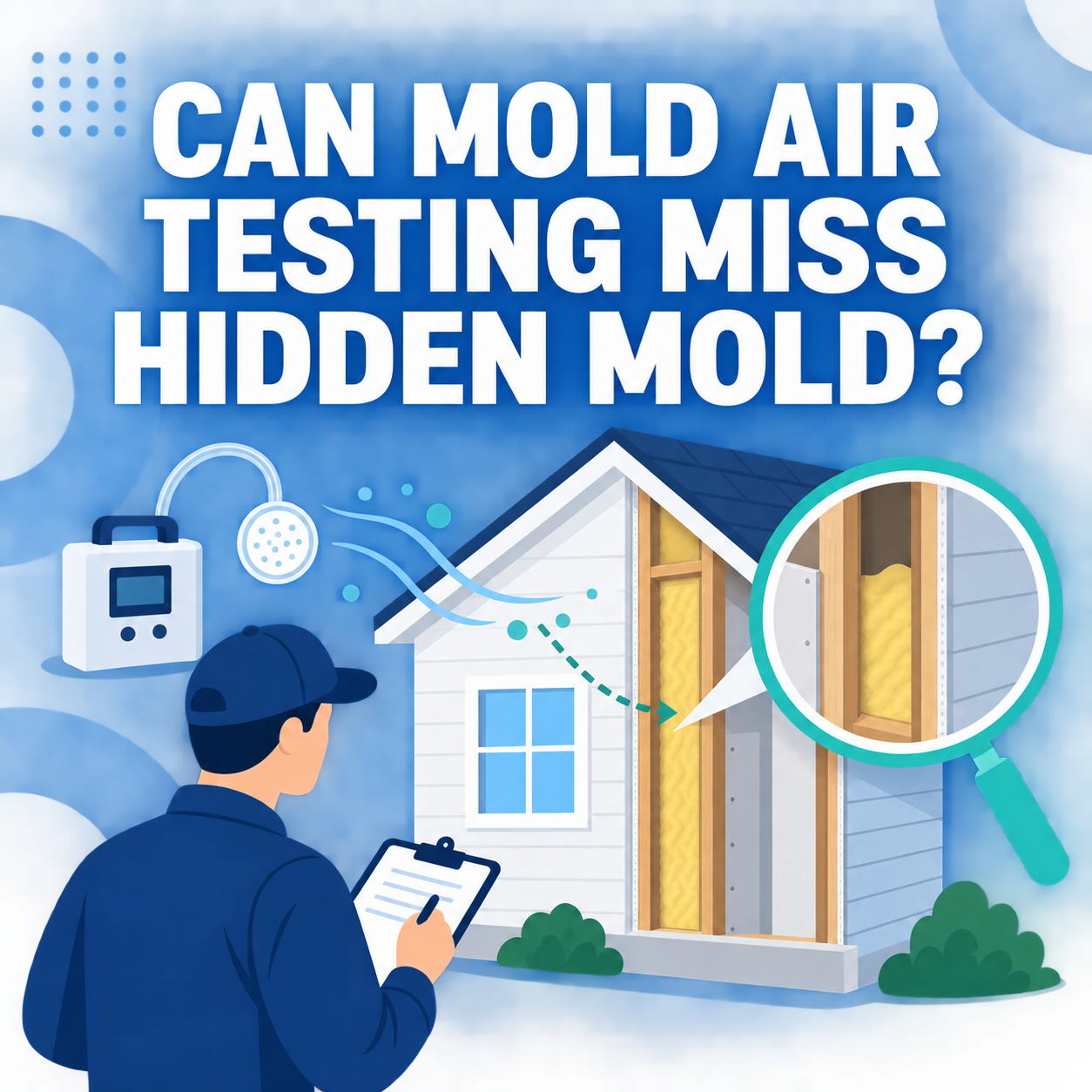
Can mold air testing miss hidden mold? Yes. An air sample measures spores suspended at one location during a short sampling period. Mold concealed behind drywall, beneath flooring, or inside cabinetry may release few spores into the occupied room, so a normal air sample cannot prove that every hidden building cavity is free of mold.
This does not mean air testing has no value. It means the results must be interpreted as one part of a mold assessment. The building’s moisture history, visible conditions, moisture measurements, HVAC operation, and sampling locations all influence what the results can reasonably tell us.
What Mold Air Testing Actually Measures
The most common mold air test uses a spore-trap cassette connected to a calibrated sampling pump. A measured volume of air passes through the cassette, where airborne particles are collected. A laboratory then identifies and counts fungal structures visible on the sample.
The result is usually reported as spores per cubic meter of air. Indoor findings are evaluated in relation to an outdoor control sample, the types of fungi detected, the condition of the building, and the reason testing was performed.
An air sample is therefore a snapshot. It does not continuously monitor the room, examine the back of drywall, or establish whether every surface is free of fungal growth. It only characterizes the airborne fungal particles captured while that particular sample was collected.
Why Can Mold Air Testing Miss Hidden Mold?
Hidden mold does not release spores into occupied air at a constant rate. Several conditions can prevent a concealed source from meaningfully affecting a room sample.
The growth may be enclosed
Mold on the back of drywall or inside an insulated wall cavity may be separated from the room by painted gypsum board, cabinetry, trim, or another relatively intact finish. If there is little air movement between the cavity and the room, few spores may reach the sampling location.
The material may be damp but undisturbed
Fungal growth can remain relatively localized while wet materials are left in place. Removing baseboards, opening a cabinet, lifting flooring, or beginning demolition may disturb the material and release particles that were not previously airborne.
This is one reason destructive work should not be used casually as a diagnostic method. Opening a suspected area without appropriate planning can change indoor conditions and spread particulate.
Airborne conditions change
HVAC operation, air filtration, cleaning, open doors, occupant activity, and recent disturbance can all affect the particles suspended in a room. Outdoor fungal conditions also vary with weather and season. A sample collected on one day should be interpreted in the context of the conditions present at that time.
The sample may not be near the source
A sample collected in the center of a large room may not characterize a concealed source beneath one cabinet or inside one section of wall. Sampling locations should be selected according to the building history and inspection findings, not simply divided evenly throughout the house.
A Normal Air Sample Does Not Mean Mold-Free
There is no practical test that certifies a home as completely free of mold. Fungal spores are naturally present indoors and outdoors, and laboratory data must be interpreted rather than reduced to a simple mold or no-mold answer.
A normal indoor fungal ecology can be reassuring. It may indicate that the sampled room did not have an unusual airborne fungal condition at the time of testing. It does not rule out a small concealed reservoir that is not communicating with the room.
The opposite is also important. An elevated air sample can identify an abnormal airborne condition, but it does not automatically locate the source. The assessor must compare the laboratory results with moisture patterns, visible evidence, construction details, and potential pathways of air movement.
How Inspectors Evaluate Possible Hidden Mold
A sound investigation begins by asking why hidden growth is suspected. A musty odor, prior plumbing leak, staining, swollen trim, damaged flooring, repeated condensation, or unexplained moisture measurement provides a more useful starting point than sampling rooms at random.
Depending on the circumstances, an assessment may include:
- Reviewing the history and duration of a leak or moisture event
- Examining accessible surfaces and adjacent rooms
- Mapping material moisture with appropriate meters
- Using thermal imaging to locate temperature patterns that warrant further investigation
- Inspecting plumbing, roofing, exterior-envelope, or HVAC components associated with the affected area
- Comparing indoor air samples with an outdoor control
- Collecting a surface or wall-cavity sample when it is likely to answer a defined question
Thermal imaging does not see mold, and a moisture meter does not identify mold. These tools help locate temperature or moisture conditions that may justify closer evaluation. Their findings must also be interpreted with an understanding of the building assembly.
In North Texas homes, concealed moisture is often connected to plumbing leaks, storm-related roof or exterior damage, condensate problems, and condensation around HVAC components. Slab-on-grade construction can also allow water from a plumbing loss to migrate beneath flooring and into adjoining rooms without producing an obvious surface pattern.
When Wall-Cavity Sampling May Help
Wall-cavity sampling may be considered when there is a specific reason to suspect growth inside a concealed space but opening the assembly is not yet justified. A small access point can sometimes be used to collect air directly from the cavity.
This method has limitations. Insulation can interfere with sample collection, the cavity may not be open from one stud bay to another, and a sample represents only the area accessed. A negative cavity result cannot clear an entire wall system. The assessor should select the location based on moisture evidence and construction details rather than using cavity testing as a general screening tool.
Sometimes a controlled exploratory opening provides more useful information, particularly when water damage is already documented and the material will probably require removal. That decision should consider the likelihood of contamination, the possibility of disturbing fungal growth, and whether containment or other precautions are appropriate.
Should You Rely on a Home Mold Test Kit?
Settling plates and do-it-yourself test kits commonly produce some type of fungal growth because mold spores are naturally present in the environment. They do not establish the source, extent, or cause of a building-related condition. They also lack the inspection context needed to decide whether concealed materials should be investigated.
If the concern involves a known leak, recurring odor, damaged building material, or a real-estate decision, the more useful question is not simply whether mold spores exist. It is whether the building has an abnormal moisture or fungal condition and what evidence supports that conclusion.
When a Professional Mold Assessment May Be Appropriate
Professional evaluation may be appropriate when:
- A musty odor persists without a visible source
- Materials remained wet or may have remained wet for an extended period
- Staining, swelling, deterioration, or suspect growth appears near a wall, cabinet, or floor
- Indoor testing was normal but moisture-related evidence remains unexplained
- A plumbing, roof, HVAC, or exterior leak affected concealed building materials
- Renovation or demolition may disturb a suspected area
- The location or extent of a mold condition must be defined before remediation
A Texas licensed Mold Assessment Consultant can determine which observations and sampling methods are appropriate for the specific building. The goal is not to collect the greatest possible number of samples. It is to develop enough reliable evidence to explain the condition and recommend reasonable next steps.
Frequently Asked Questions
Can an air sample detect mold growing behind drywall?
It may detect spores entering the room from a concealed source, but it cannot confirm that every wall cavity is free of growth. Results depend on air movement, source activity, sampling location, and conditions during collection.
Can mold be present if the laboratory report says indoor levels are lower than outdoors?
Yes. Lower indoor counts may indicate that the sampled air was not unusually affected, but localized mold can still exist on a concealed material without significantly influencing the room sample.
Should walls be opened when mold is suspected?
Not automatically. An assessor should first evaluate the moisture history, accessible conditions, and non-destructive findings. If an opening is justified, it should be planned to limit unnecessary damage and particulate spread.
Is wall-cavity testing better than room-air testing?
Neither method is universally better. They answer different questions. Room-air sampling evaluates airborne conditions in an occupied area, while cavity sampling targets a particular concealed space. Both have limitations.
Can air testing determine where the moisture came from?
No. Laboratory testing characterizes fungal particles, not the cause of moisture. Determining the source requires inspection of plumbing, roofing, exterior components, HVAC equipment, drainage, or other relevant building systems.
Mold air testing can miss hidden mold because a concealed source may not release enough spores into the sampled room during the collection period. A normal result is useful information, but it is not proof that every wall, floor, or cabinet cavity is free of growth.
The most reliable conclusions come from combining laboratory data with moisture mapping, visual observations, building history, and an understanding of how water and air move through the structure. When evidence continues to suggest a concealed problem, the next step should be a targeted investigation rather than random additional testing or immediate demolition.
Related Articles
- Understanding the Difference Between Mold Assessment and Mold Testing
- Understanding a Normal Fungal Environment
- How Do I Know If a Water Leak Has Caused Hidden Mold?
- What to Expect During a Mold Inspection
Dennis Butts is a Texas licensed Mold Assessment Consultant and principal of NTX Enviro Consulting Services, providing mold inspections, remediation protocols, and post remediation verification services throughout North Texas.
NTX Enviro provides professional mold inspections and moisture evaluations for homeowners throughout North Texas.