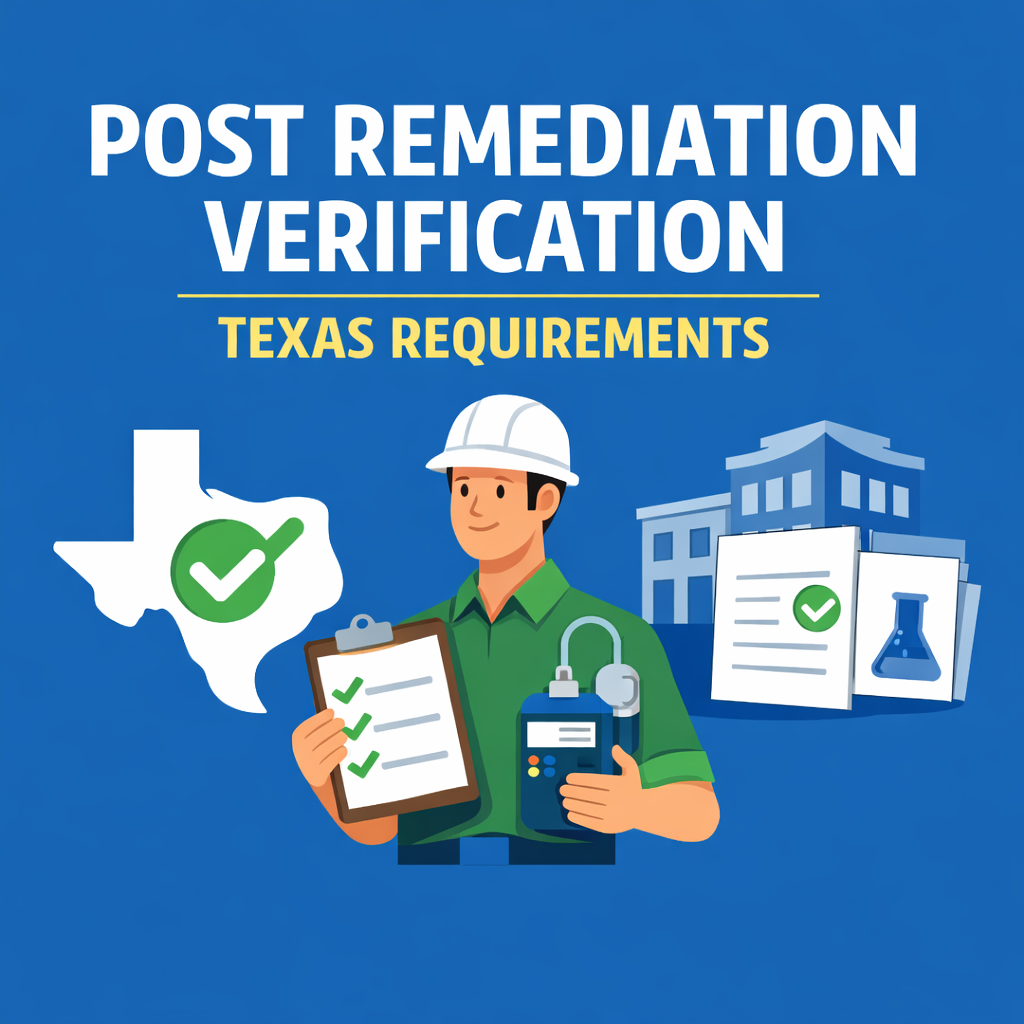
When mold remediation is completed, many homeowners assume the problem has been fully resolved. However, without proper Post Remediation Verification, there is no independent confirmation that the remediation was successful.
In Texas, post remediation verification, commonly referred to as PRV, plays a critical role in ensuring that mold contaminated materials were properly removed, the affected area was adequately cleaned, and conditions are suitable for reconstruction. PRV is not simply a formality. It is a regulated process governed by the Texas Mold Assessment and Remediation Rules.
How Post-Remediation Verification Fits Within Texas Mold Regulations
When a mold remediation project involves more than 25 contiguous square feet of material that must be cleaned or removed to address visible mold growth, Texas law requires the work to be performed by a licensed Mold Remediation Contractor. At the completion of the project, the contractor must issue a Mold Remediation Certificate (MRC) confirming that the work was performed in accordance with the Texas Mold Assessment and Remediation Rules.
Importantly, the threshold is based on the amount of material cleaned or removed to remediate visible mold growth, not strictly the size of visible growth itself. This distinction is often misunderstood.
Post-remediation verification (PRV) may also be performed by a licensed Mold Assessment Consultant to evaluate whether the work area has been properly cleaned and whether containment conditions are suitable for removal. Although PRV testing is optional, it is commonly requested by property owners, contractors, and other parties because it provides independent third-party documentation of the remediation outcome before the work area is returned to normal use. It is also required if the client wants a Texas Department of Insurance Certificate of Mold Damage Remediation (CMDR).
The purpose of PRV is to provide independent confirmation that remediation was performed in accordance with the remediation protocol and applicable standards.
What Happens During Post Remediation Verification
A proper PRV typically includes:
- A visual inspection of the containment area
β’ Confirmation that mold affected materials were removed as specified
β’ Verification that surfaces are free of visible dust and debris
β’ Moisture measurements to confirm materials are dry
β’ Air sampling when appropriate
The Mold Assessment Consultant must determine whether the remediation area meets clearance criteria before issuing a written clearance report.
Clearance is not based on a single air sample alone. It involves a combination of visual assessment, moisture evaluation, and when necessary, laboratory analysis.
π Why Moisture Mapping Is Critical Before Mold Remediation in Texas Homes
Why Independent Verification Matters
One of the most important aspects of PRV is independence. In Texas, the Mold Assessment Consultant cannot be employed by or have a financial interest in the remediation company performing the work. This separation protects property owners by ensuring that clearance decisions are unbiased.
Without independent verification, there is a risk that:
- Residual contamination remains in concealed areas
- Containment was removed prematurely
- Moisture sources were not fully corrected
- Reconstruction begins before conditions are appropriate
PRV provides documented confirmation that remediation objectives were achieved.
π Understanding the Difference Between Mold Assessment and Mold Testing
When PRV Protects Property Owners
Post Remediation Verification is especially important in real estate transactions, tenant disputes, insurance claims, and projects involving significant water intrusion. A clearance report provides defensible documentation that remediation was properly completed.
For property managers and commercial building owners, PRV also reduces liability exposure by establishing that the project met regulatory requirements.
The Risk of Skipping Clearance
Skipping PRV may save time in the short term, but it can create long term risks. If mold returns because moisture was not corrected or contamination was not fully removed, additional remediation may be required.
More importantly, lack of clearance documentation can complicate property sales or future claims. In regulated projects, failing to obtain proper clearance can also create compliance concerns under Texas law.
Post remediation verification is not about creating additional steps. It is about confirming that the work was done correctly the first time.
If you are planning mold remediation or have recently completed a project, scheduling independent Post Remediation Verification ensures your property meets Texas requirements and is ready for safe reconstruction.
Looking for a licensed consultant to perform independent clearance testing?
π Schedule a Professional Mold Inspection with NTX Enviro Today
Dennis Butts is a Texas-licensed Mold Assessment Consultant (MAC) and principal of NTX Enviro Consulting Services. He provides mold inspections, remediation protocols, and post-remediation verification services throughout North Texas.