📞 (972) 643-8379 Monday to Friday 8:00 am - 5:00 pm, Saturday & Sunday - CLOSED

How Long Does Drywall Take to Dry After a Water Leak?

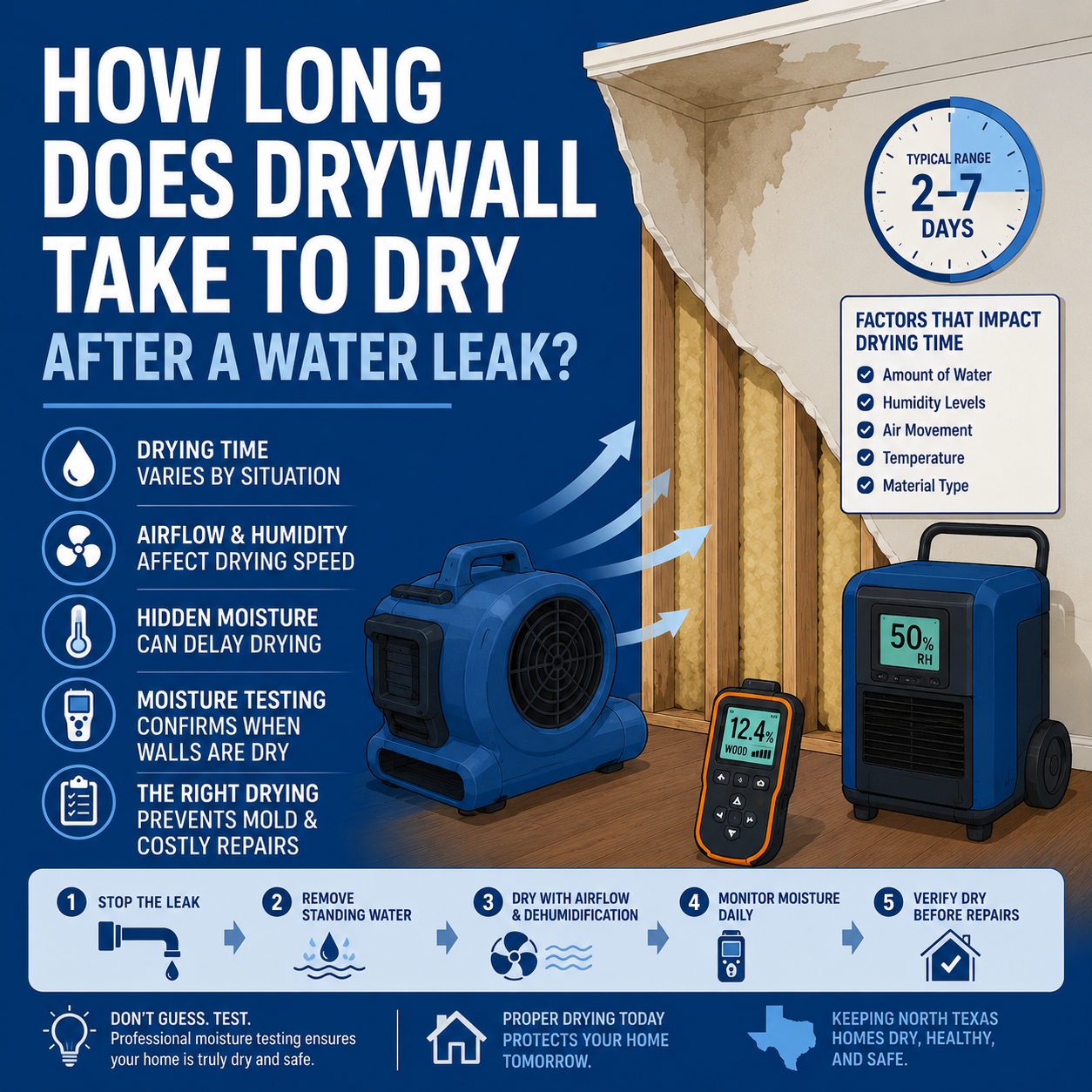
Drywall can begin drying within hours after a water leak, but reaching normal moisture levels often takes several days. The exact drying time depends on how much water entered the wall, the indoor environment, airflow, humidity, and whether moisture is trapped inside the wall cavity. A wall that feels dry to the touch may still contain hidden moisture.
There Is No Standard Drying Time
One of the first questions homeowners ask after a plumbing leak is, “How long until the wall is dry?”
The honest answer is that every situation is different.
A small supply line leak caught immediately may allow drywall to dry within two or three days. A ceiling saturated by a second-floor leak or roof intrusion may require significantly longer.
Professional drying is based on moisture measurements rather than the number of days that have passed.
What Affects Drying Time?
Several factors influence how quickly drywall releases moisture.
Amount of Water
- Minor wetting from a slow leak dries much faster than drywall that has become saturated.
- The deeper moisture penetrates into the gypsum core and surrounding framing, the longer drying typically requires.
Indoor Humidity
- High indoor humidity slows evaporation.
- During North Texas summers, outdoor humidity often limits how efficiently moisture can leave building materials unless dehumidification is used.
Air Movement
- Air movers increase evaporation by continuously replacing humid air at the material surface with drier air.
- Without sufficient airflow, moisture removal slows considerably.
Temperature
- Warmer air generally supports faster evaporation than cooler conditions.
- Professional drying contractors balance temperature, humidity, and airflow to maximize drying without damaging materials.
Why Walls Can Feel Dry Too Soon
Painted drywall often becomes dry on the surface while moisture remains deeper inside.
This is particularly common after:
- Plumbing leaks
- Roof leaks
- Window leaks
- HVAC condensate overflows
Without moisture testing, homeowners may assume the wall has completely dried when moisture is still present behind the paint.
That remaining moisture can delay repairs and, under the right conditions, contribute to microbial growth.
What Professionals Monitor During Drying
Restoration professionals typically establish drying goals by comparing wet materials with unaffected portions of the building.
They may monitor:
- Drywall moisture content
- Wood framing moisture
- Indoor temperature
- Relative humidity
- Dew point conditions
- Daily moisture trends
Rather than relying on a fixed schedule, they continue drying until moisture readings stabilize within acceptable ranges.
Why Hidden Moisture Is the Biggest Concern
Water often travels farther than homeowners expect.
Moisture may migrate into:
- Wall insulation
- Bottom plates
- Stud cavities
- Baseboards
- Adjacent rooms
Gravity, capillary action, and air movement can spread moisture well beyond the visible stain.
This is one reason moisture mapping is an important part of evaluating water damage.
Can You Speed Up the Drying Process?
Drying can often be improved by:
- Correcting the leak immediately.
- Removing standing water.
- Increasing air circulation.
- Using commercial dehumidifiers.
- Maintaining consistent indoor temperatures.
- Monitoring moisture until drying is complete.
Household fans alone may help with evaporation, but they cannot verify whether building materials have actually dried.
Why Moisture Testing Matters Before Repairs
Replacing drywall too early wastes materials.
Painting too early can trap residual moisture.
Installing insulation or flooring before surrounding materials have dried may create concealed moisture problems that become apparent weeks or months later.
Professional moisture verification helps determine when reconstruction can safely begin.
When Should You Consider a Mold Assessment?
A licensed Mold Assessment Consultant may recommend additional evaluation if:
- The wall remained wet for several days.
- Moisture readings remain elevated.
- A musty odor develops.
- Visible mold appears.
- The leak source was not immediately identified.
- Water entered concealed wall cavities.
Identifying lingering moisture early often prevents much larger repairs later.
Frequently Asked Questions
Can drywall dry without removing it?
Yes. Drywall exposed to clean water can often be dried successfully if moisture exposure was limited and drying begins quickly.
Is a water stain proof that the wall is still wet?
No. Water stains may remain long after the wall has completely dried.
How do inspectors know when drywall is dry?
Moisture meters are used to compare affected materials with unaffected areas until acceptable drying levels are achieved.
Does insulation dry as quickly as drywall?
Not always. Some insulation materials retain moisture much longer and may require replacement depending on the extent of water exposure.
Should I wait before repainting?
Yes. Repairs and painting should generally wait until moisture testing confirms the drywall has returned to normal moisture levels.
Drywall drying time depends on much more than the calendar. Moisture exposure, humidity, airflow, and hidden water inside the wall all affect how quickly building materials return to normal. Rather than relying on appearance or touch, professional moisture measurements provide the most reliable way to determine when a wall is truly dry and ready for repairs.
Related Articles
- How Do I Know If a Water Leak Has Caused Hidden Mold?
- Why Moisture Mapping Is Critical Before Mold Remediation in Texas Homes
Dennis Butts is a Texas licensed Mold Assessment Consultant and principal of NTX Enviro Consulting Services, providing mold inspections, remediation protocols, and post remediation verification services throughout North Texas.
NTX Enviro provides professional mold inspections and moisture evaluations for homeowners throughout North Texas.

[…] How Long Does Drywall Take to Dry After a Water Leak? […]