📞 (972) 643-8379 Monday to Friday 8:00 am - 5:00 pm, Saturday & Sunday - CLOSED

Can Wet Insulation Cause Mold in Your Home?

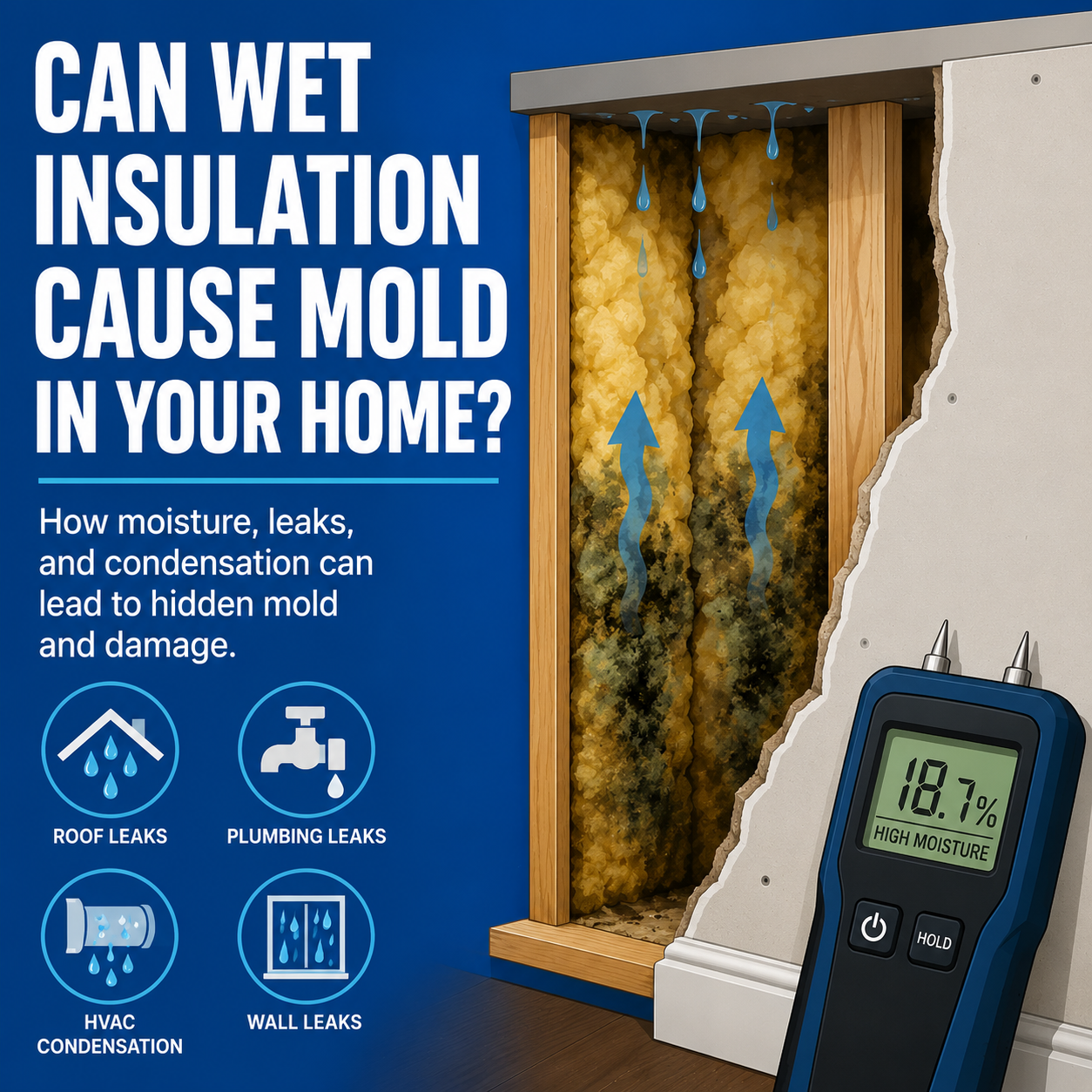
Yes. Wet insulation can contribute to mold growth when moisture remains trapped inside a wall, ceiling, attic, or floor assembly. The insulation itself may or may not provide a strong food source, but surrounding drywall paper, wood framing, dust, and other organic materials can support mold growth.
The primary concern is not simply whether insulation became wet. The more important questions are how long it remained wet, what type of insulation is present, whether nearby materials were affected, and whether the moisture source has been corrected.
Why Wet Insulation Creates a Hidden Moisture Problem
Insulation is installed inside areas that are not normally visible. Once it becomes wet, it may hold moisture against framing, drywall, roof decking, or subflooring.
This creates several problems:
- Drying is slower inside enclosed cavities.
- Moisture can spread beyond the visible stain.
- Damp materials may remain concealed after surface finishes appear dry.
- Mold growth can occur on nearby organic building materials.
- Insulation may lose some of its thermal performance.
A ceiling stain may dry and appear minor while the insulation above it remains damp. Similarly, drywall may feel dry from the occupied side even though the backside and insulation inside the wall cavity are still wet.
Common Causes of Wet Insulation
During moisture investigations, wet insulation is commonly associated with several recurring conditions.
Roof Leaks
Roof leaks often wet attic insulation before the damage becomes visible on the ceiling below.
Water may enter through:
- Damaged shingles
- Failed flashing
- Roof penetrations
- Plumbing vents
- Valleys
- Chimney transitions
- Hail-damaged roofing components
North Texas thunderstorms and hail events can create small roof defects that do not produce immediate dripping. Moisture may first appear as damp insulation, staining on roof decking, or discoloration along ceiling drywall.
Plumbing Leaks
Plumbing lines often run through walls, ceilings, and attic spaces. A small supply line leak can saturate insulation while producing only limited visible damage.
Common sources include:
- Water heater connections
- Bathroom supply lines
- Shower plumbing
- Drain lines
- Refrigerator water lines
- Washing machine connections
The insulation can absorb and redistribute water, making the affected area larger than the original leak point.
HVAC Condensation
Air conditioning systems can also wet insulation.
Potential sources include:
- Condensate drain blockages
- Overflowing drain pans
- Sweating ducts
- Uninsulated refrigerant lines
- Air leakage around supply boots
- Poorly sealed plenums
During long North Texas cooling seasons, cold HVAC surfaces are frequently surrounded by warm, humid attic air. If insulation is missing, compressed, or poorly installed, condensation can develop and repeatedly dampen nearby materials.
Exterior Wall Leaks
Wind-driven rain can enter around windows, doors, wall penetrations, and exterior cladding defects.
When water enters an insulated wall cavity, the damage may remain concealed until baseboards swell, paint begins peeling, or a musty odor develops.
Does All Wet Insulation Grow Mold?
Not necessarily.
Mold growth depends on several factors, including:
- Duration of moisture exposure
- Temperature
- Available organic material
- Air movement
- Type of insulation
- Condition of adjacent materials
Fiberglass insulation itself is primarily inorganic and is not generally considered a strong food source. However, dust, paper facings, debris, and surrounding building materials can support mold growth.
Cellulose insulation is made from recycled paper products and is more absorbent. Once significantly wet, it can retain moisture and may be more difficult to restore.
Spray foam insulation responds differently depending on whether it is open-cell or closed-cell. Open-cell foam can absorb and retain more moisture, while closed-cell foam is less permeable. Even when the foam itself remains intact, moisture may become trapped against framing or roof decking.
How Long Can Insulation Stay Wet Before Mold Develops?
Mold growth does not follow an exact countdown, but prolonged dampness increases the risk.
Growth may begin within a few days under favorable conditions, especially when insulation remains in contact with drywall paper, wood, dust, or other organic materials.
The often-cited 24 to 48-hour drying goal is useful as a general moisture-management principle, but it should not be treated as a guarantee. Materials that remain wet beyond that period are not automatically mold-contaminated, and materials dried sooner are not automatically unaffected.
The actual condition should be evaluated based on moisture, material type, visible observations, odor, and exposure history.
Signs That Insulation May Be Wet
Because insulation is usually hidden, homeowners often notice indirect evidence first.
Possible signs include:
- Ceiling stains
- Peeling paint
- Sagging drywall
- Musty odors
- Dripping from light fixtures
- Swollen baseboards
- Damp attic decking
- Condensation around HVAC components
- Elevated moisture meter readings
- Repeated staining after rain
A stain does not always indicate active moisture. It may remain visible long after the material has dried. Conversely, the absence of staining does not prove that insulation is dry.
How Wet Insulation Is Evaluated
A moisture assessment typically begins with the visible area and expands outward based on the observed pattern.
Common inspection methods include:
- Visual inspection
- Moisture meter screening
- Thermal imaging
- Attic inspection where safely accessible
- Indoor temperature and humidity measurements
- Review of leak history
- Comparison readings in unaffected areas
- Limited access openings when necessary
Thermal imaging may help identify temperature differences associated with evaporation or insulation irregularities. However, it does not directly confirm moisture.
Moisture meters can help identify affected drywall, wood, or other materials, but readings must be interpreted carefully. Insulation itself is often difficult to evaluate accurately without physical access.
Can Wet Insulation Be Dried in Place?
Sometimes, but not always.
The decision depends on:
- Insulation type
- Amount of water
- Water category
- Duration of exposure
- Whether the cavity can be opened
- Condition of adjacent materials
- Presence of visible mold
- Whether drying can be verified
Small areas of lightly damp fiberglass insulation may sometimes dry if the moisture source is corrected and the cavity is opened to allow airflow.
Saturated, compressed, contaminated, or visibly mold-affected insulation is more likely to require removal.
Cellulose insulation often mats together when wet and may lose its effectiveness. It is commonly removed when substantially saturated.
Insulation affected by sewage, groundwater, or other contaminated water should not be treated the same as insulation affected by a small clean-water leak.
Why Surface Dryness Can Be Misleading
Homeowners often check the visible drywall and assume the assembly is dry once the surface no longer feels damp.
That can be misleading because wall and ceiling systems dry at different rates.
For example:
- Paint may slow evaporation.
- Vinyl wall coverings can trap moisture.
- Insulation may remain wet behind dry drywall.
- Wood framing can retain moisture longer than the surface finish.
- Closed cavities may have little air movement.
A proper moisture evaluation considers the entire assembly, not just the exposed surface.
Can Air Testing Confirm Mold in Wet Insulation?
Air sampling cannot determine with certainty whether mold is present inside insulation.
A concealed cavity may contain localized growth without releasing enough spores to significantly affect the room air. On the other hand, an elevated air sample does not identify insulation as the source.
Air sampling may provide useful supplemental information, but it should be interpreted with:
- Moisture findings
- Visible conditions
- Leak history
- Building materials
- Odor
- Inspection limitations
When the concern is wet insulation, direct evaluation of the affected assembly is usually more informative than air sampling alone.
Should Drywall Be Removed to Check the Insulation?
Not automatically.
Removal may be appropriate when:
- Moisture remains elevated.
- The leak was prolonged or repeated.
- Drywall is soft, swollen, or deteriorated.
- A musty odor persists.
- Visible suspect growth is present.
- The cavity cannot be adequately evaluated otherwise.
- Drying cannot be verified.
Limited access openings can sometimes provide enough information without removing an entire wall or ceiling section.
The goal should be targeted investigation rather than unnecessary demolition.
When Professional Evaluation May Be Appropriate
Professional evaluation may be appropriate when:
- Insulation was saturated.
- A roof or plumbing leak went unnoticed.
- Ceiling or wall materials remain damp.
- The moisture source is uncertain.
- A musty odor continues after drying.
- Visible suspect growth is present.
- Multiple areas appear affected.
- The problem involves an attic, wall cavity, or other concealed space.
A moisture investigation can help define the affected area, identify the likely source, and determine whether insulation or surrounding materials require removal.
Frequently Asked Questions
Can fiberglass insulation grow mold?
Fiberglass itself is not a strong food source, but mold can grow on dust, paper facings, wood, drywall paper, and debris associated with the insulation.
Does wet insulation always need to be replaced?
No. Limited dampness may sometimes be dried, but saturated, contaminated, compressed, or mold-affected insulation is more likely to require removal.
Can insulation feel dry but still contain moisture?
Yes. The exposed surface may feel dry while moisture remains deeper within the insulation or against adjacent framing and drywall.
Will a dehumidifier dry insulation inside a wall?
A dehumidifier may help reduce ambient humidity, but it may not fully dry insulation inside a closed cavity. Opening the assembly may be necessary.
Can wet attic insulation damage the ceiling below?
Yes. Wet insulation can hold moisture against ceiling drywall, increasing the risk of staining, sagging, deterioration, and mold growth.
Wet insulation can contribute to mold growth by holding moisture against drywall, framing, roof decking, and other organic materials. The insulation type, duration of exposure, water source, and ability to verify drying all affect whether the material can remain in place.
A visible stain alone does not reveal the full extent of the problem. Moisture mapping, inspection of accessible areas, and targeted access may be necessary to determine whether the insulation and surrounding materials are dry, damaged, or mold-affected.
Related Articles
- How Long Does It Take for Mold to Grow After Water Damage
- How Do I Know If a Water Leak Has Caused Hidden Mold?
- What Do Moisture Meter Readings in Walls Really Mean?
- Why Attic Moisture Problems Often Go Unnoticed in Texas Homes
Dennis Butts is a Texas licensed Mold Assessment Consultant and principal of NTX Enviro Consulting Services, providing mold inspections, remediation protocols, and post remediation verification services throughout North Texas.
NTX Enviro provides professional mold inspections and moisture evaluations for homeowners throughout North Texas.